To view more visit Jutta Scheiner on Instagram.
Featured in Issue One: Gold in the Soil.
*All artwork is featured with the permission of the artist. Please be sure to ask for permission before republishing or sharing any content.


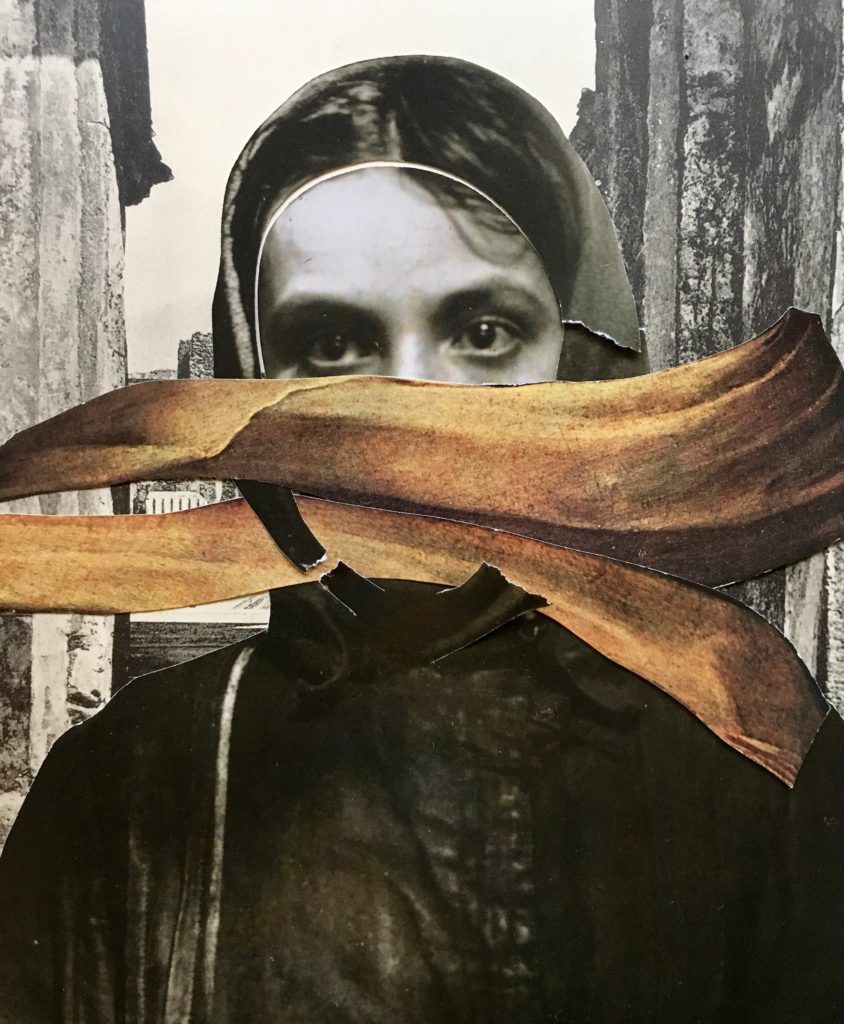

To view more visit Jutta Scheiner on Instagram.
Featured in Issue One: Gold in the Soil.
*All artwork is featured with the permission of the artist. Please be sure to ask for permission before republishing or sharing any content.
by
Trace Ramsey
A horse chestnut tree aged in the front yard of my grandparents’ house on Maltby Road, just beyond the border of the tiny town of Oakfield, New York. With slight pressure, the tree’s shabby bark flaked off in palm-sized pieces, revealing bright orange below dull gray. The tree matched the asphalt siding of the house, gloomy and coarse. Gone now are both tree and house, their spaces taken over by a field in which a farmer rotates cash crops of corn, soybeans, and wheat. My father says each fall the bedroom where he grew up now sprouts in rows of corn. I picture the soil stubbled like a great unshaven face. My father envisions his bed among the crops.
This spring, I looked up the address to see a current Google street view. On the computer screen appeared a space of field and sky, an unrecognizable place where so many times I ran under that horse chestnut, gathered its seeds and hulls, touched its sticky growing buds in spring.
“Will these turn me into a horse?” my brother once asked me, bringing the nut close to his mouth.
“Don’t you eat that, dummy. You’ll be sick for days.” I only knew because my father once told me something similar.
In stiff autumn winds, the nuts fell like coins from a change purse. When we got together, my brother, cousins, and I loaded the pockets of our sweatshirts with seeds and chased each other around the tree and off into the sprawling front yard. I threw the seeds at their backs, listening for the dull whump of a connecting hit. They returned throws in my direction. The exchange ended with each of us bent in half, hands gripping our knees. We panted and laughed into the developing dusk. The next day our shoulders burned. But that night we wiped the sweat from our faces and ate baked beans with bacon and onions on top.
Most of the outer shells of the horse chestnut seeds remained attached to the tree, blackening in that space above us, decaying in the branches. From below, the thousands of open casings looked like regurgitating birds feeding their young. We boys regarded the rare seed that fell from the tree with the outer hull intact as a special and powerful weapon. We never threw those during our battles with each other. Instead, we kept these unusual chestnuts on dresser tops or closet shelves until the outer layer turned black and fell away, revealing the glossy dark seeds under the husks. The seeds themselves became desiccated, shriveling from the inside without the requirements for growth: light, water, desire.
A seed stores life. One of my farmer friends says a seed is, metaphorically, the promise of a future. In Southern folklore, opening the seed of a native persimmon predicts the winter to come; finding the shape of a spoon tells of a heavy wet snow, the spoon representing a shovel. A knife predicts icy winds, the knife symbolizing the wind cutting into you. A fork is the most desirable shape. The fork tells of a mild winter and the possibility of a small trace of snow. I can’t remember what the fork represents. I found that it doesn’t matter what the folklore says: after splitting dozens of persimmon seeds over several years, I never found a shape that was anything other than a spoon.
That horse chestnut tree died in an ice storm in 1991. That was the same year my grandfather died alone in a nursing home just north of Attica. I was a high-school junior working nights at one of the two grocery stores in town. My boss sent flowers. We boys—brothers and cousins—sat in the back of the funeral home and told each other dirty jokes.
* * * * *
My father taught me how to swim by lobbing me into the middle of the pool behind our trailer. I left his arms and dropped in deep, returning to the surface by thrashing and jerking. Between gasps for air, I reached for the side of the pool. I learned to stay above the water’s surface by lunging to the nearest solid surface. Each of my four limbs acted against the others’ progress, my torso helpless as its attachments forgot that they were inseparable. My hands clapping into the water became something resembling a swimming stroke. My legs moved in frantic downward kicks, straining for the bottom. I struggled, making movements that imitated a fish expelling a hook caught deep in its gills.
“I can’t… I can’t swim…” The salt from tears and snot made it into my mouth. My nose and throat burned from the chlorine in the water. I swallowed and spit and coughed into the air when I could get to the surface.
When I reached the pool edge, my father lifted me from the water by my forearms. My smooth torso brushed against the hair of his shirtless chest. He looked me in the face, his mouth molded into a grin. He held me as the water slipped from my hair and along the edges and curves of my reddening face. I got a whiff of his breath—a punch of pilsner, a pinch of bourbon—just before he threw me, crying, back into the water.
His method continued. He hurled me in and pulled me out, on and on as other children played in the water and their mothers lay on the pool deck on their bellies, their bikini tops untied, cheap canned beers sweating beside their browning shoulders. No matter which side of the pool I grasped, my father was there to pluck me from the water and toss me back out to the middle.
Adults and older children surrounded me, giggling yet protecting me in a way. They knew of the lesson I was receiving and understood that nothing awful would happen. I did not have the same understanding until well after we put the pool toys away and threw the towels into the wash. This is the way my father learned, my grandfather throwing him into a pond from the edge of a boat dock.
“You have it easy. Grampa learned by falling into an old well,” he told me with a smirk as I shivered and spit on the warm deck of the pool. I didn’t know it was a joke then.
I imagine that the fear my father once clenched in his stomach had aged and become nostalgia, a flowered then withered then decomposed bit of experience with no current equivalent in his life. His father is dead. He no longer sees the weaknesses in their relationship or thinks his swimming education was much more than playful fun. And this presents the problem, at least in a philosophical way—my father is very much alive, our relationship loving and solid regardless of a physical separation of hundreds of miles. He had a rough teaching method bordering on the
cruel, yet I forgot his process as I became confident in the water.
* * * * *
My father and his twin brother made a trek to see the Maltby Road house before the volunteer fire department used it as a practice burn. It had been vacant for years. When my father tells me and my partner Kristin the story, I envision the brothers walking around the edges of the house, pointing out where they used to camp out all summer because the house was too hot, talking about where they used to park and what grew best in the small garden.
“You remember when we chased that skunk under the house?” My father laughs as he asks, knowing an incident like that is not something you forget.
“Brother”—my uncle calls my father Brother exclusively—“that was something.”
I see them there on the porch, stepping so as not to crack the boards that rise above the bare soil below the rotten wood. In front of the door lays a moldy phone book in a clear plastic bag, a reminder to my father about how long the house did not have a phone, how long they went without many things.
He tells us about going without necessities. “Alcohol and cigarettes kept us poor, coming before all else, before food, before rent. Hell, we didn’t even have a car until I was a teenager.”
My uncle has on ill-fitting sweat pants, his gut pressed against the fabric of the shirt on top. He is doing the talking while my father pushes the door open and steps into the thinly carpeted living room. My uncle is the one who brings guns to those rare get-togethers at my father’s house, not to shoot but to show off his newest purchase.
“You ever see one of these?” he’d ask, pulling a rifle from its immaculate, dark case, holding it up so that the afternoon light sparkled in the lens of the scope and along the grain of the stock.
“Yeah, I sold one like that a few months ago,” one of my brothers would say. My uncle would give the gun another quick appraisal, this time with less pride, and slide it back into case, back into his truck, back out of our way.
Looking at the ceiling, my father pushes his glasses up a few times—a tick he doesn’t realize he has—and wipes the sweat from his forehead before replacing the Buffalo Bills hat over his baldness. My uncle joins his gaze, looking at whatever each of them think they see, the same mist we all glimpse when we search our incredible depths of memory. These two men are twins, anyone can see that in their faces. But my uncle is heavy and does not appear to be well. He needs a new kidney, is on the top of the list of recipients. Dialysis will do that to a person, make them look as ill as they are, turn their skin a slight yellow tone like a bruise that has almost healed. My father has the paunch of a man in late middle-age, but keeps busy in his retirement, still working every day installing new electrical service to homes and barns or plowing fields for several farmers in the area.
During their visit, they felt the need to touch the dusty countertops and peer beyond bedroom doors. They opened closed drawers, checked old newspapers for the date. They touched everything familiar, but they didn’t recognize themselves in that space. My father told me he never felt so distant from himself, so removed from his own history even as it confronted him in physical form. “It was like looking at a magazine,” he said.
As kids, we visited the house often. My father’s house and the Maltby Road house were in two different towns but connected by one other road and one right-hand turn. My brother and I sometimes biked the distance. Even with all those visits, the house exists in fragile memory for me. Since I never lived in the house, I borrowed my connection to it, focusing on the fun, not knowing or understanding the pain. It exists otherwise for my father, in very distinct ways. When he was five, he suffered through rheumatic fever in his tiny bedroom, which ruined his heart forever. On the front porch, he listened as his twin brother read a draft notice. In the family room he watched daily as his mother sat and drank a gallon of wine, becoming glossy-eyed and abusive.
Now that my father has read a few of the pieces I have written about him, I am wary he is stretching things, inserting flourishes into his stories of childhood to see if they make it into one of my essays. It is hard to know, for example, if his mother had a piano in that house that only she played and that my grandfather smashed apart. It fits, this tale of destruction in a house held together with empty wine jugs and cigarette smoke and what seems to be a genuine hatred for one another.
I was three years old, the same age as my daughter Tennessee, when I last saw my grandmother. She lay flat on a rented hospital bed parked edge-long between the couch and the television in the front room of the house. The windows caught markings of sunlight splitting through the empty branches of the horse chestnut tree. I viewed my grandmother’s body in curiosity and apathy. She had spoken and carried on loudly in life, the cough of her cigarette ruined lungs rattling throughout the massive house even in her last days. In death, her dormant frame hushed the room. In the silence, I stood looking through the screen door watching the cars and tractors pass by, their transience a convenient assurance of the fundamentals: we are never alone and everyone dies.
Tennessee can listen to the stories of these people she will never meet, but the house and its former inhabitants remain non-existent memories for her, simple myths. No physical evidence connects her to the place; she has no reason to care about or hear of its existence. Without thinking, my family removes the house from its generational memory, extinguishing any importance it may have held by taking a path of forgetting.
The brothers left the place as it had existed for years—blank, stale, purged of the warm blood that used to cycle through it. Vines grew through broken windows. The floors had damp spots and stains from countless leaks in the roof. The walls were wild with a mixture of unfurling wallpaper and black mold. Beetles and crickets multiplied behind the walls. Then the Oakfield volunteer fire department burned it.
Most of the people who had ever lived in the house were dead. My father and uncle had moved away healthy and single, ready to live. Now my father’s body carries a pacemaker and forty-five years’ worth of daily alcohol use; his twin brother—ears ruined in Vietnam, knees crumbling from decades of driving an Agway feed truck—awaits that new kidney. Just like the house, they can’t escape age and disrepair for too much longer. As for the others—the parents who raised them, the brothers and sisters who shared the supper tables and the arguments and the four walls of the house—they are buried in Oakfield and Pittsburgh and Rochester and Elba. Simple shovels buried the people; a backhoe buried the house.
* * * * *
A few years after my swimming instruction, it was time for my brother to learn. By this time, I could take part in the instruction. I laughed at how foolish he looked, how his small, bright hands slapped the surrounding water. Gone were my own thoughts of how much pain I felt from gulping water, how embarrassed I felt for crying and screaming, how much revenge I craved. My brother was as helpless as I had been, his face contorted into a weird crying smirk.
At twenty-one years old, my brother jumped from the roof of a building, breaking most of the breakable parts of his body. His bones shattered into multiple pieces; nerve endings and memories erased. As the ambulance approached, the blood whined in his ears, the sound as unpredictable as a screaming child. He held his eyelids closed with pain and spite, his whole-body rigid, traveled, abused. He found out you can’t learn how to fly the same way you learn how to swim.
When he jumped from the roof, he wasn’t reflecting on how the uncertainty principle states how we cannot recognize, at the same instant, both where in space a particle exists, and how fast it moves. He wasn’t thinking about how shooting stars are not stars, just forgotten satellites entering and disintegrating within the atmosphere. He wasn’t questioning which Axiom was more important, Euclid’s Axiom of Parallels or the more modern Axiom of Choice. Instead, he was full up with methamphetamine and thinking no one loved him.
As he fell, he may have understood that humans have the power to discard a known present for an uncertain future. What he might not have known was that he would survive his fall, that he would be immobile for a time as his skeleton healed around permanent steel rods, that he would face months of boredom and painful therapy, that, when sitting at a computer for hours and typing detailed messages into Internet chat rooms, he would meet his future wife. His violent meeting with a dark and impervious surface became the seed from which a family of five and his own small business would emerge.
* * * * *
“Do you mind if we take the long way?” I asked, even though Kristin wouldn’t know the long way from the short way. We were driving to Buffalo for my sister’s wedding rehearsal. There was plenty of time, no reason to rush. I made sure we left early just so I could drive around roads I had not traveled in a long time.
“Sure, why?”
“There’s something I want to drive by and see.” My father told me what had happened to my grandparents’ house on Maltby Road, but I needed to see it for myself. I spent so much time at that house that I did not believe it was gone. I found the story of the house disappearing interesting, a fire department setting it ablaze on purpose so that people could practice what to do when it mattered, could crawl low through the smoke in full gear and work in that heavy heat.
Kristin never saw the Maltby Road house even though it still stood during the early part of our relationship. We enclosed ourselves in learning how the two of us fit together. I didn’t think to mention a remote Ramsey family home located five states away. She never knew the road’s name or how it might have any importance to me or herself or Tennessee. She hadn’t met my father’s father and couldn’t guess his name, but she could select him from a lineup of old white men. My father shares his father’s features—the jawline, the forehead, the ears, the brown eyes. Even with my green eyes, my face is following the same course. The only thing that makes me stand out is my full head of hair; both my father and grandfather went bald well before forty.
As we drove, unfamiliar new homes marked the way on each side. I knew we were close, but the unfamiliar made me question whether we had passed the place where the house used to stand. I only recognized the home’s former position after topping an easy-sloped hill with a small bridge at the bottom. Orange and black warning signs on each corner marked where the pavement narrowed at the bridge. When I saw the bridge, I knew where we were. I found a rough, stony pull-in where the driveway used to be, now a bare patch of ground used as a place to turn tractors around and attach implements. I recognized nothing; there was nothing to look at, anyhow. Years of plowing and disking pulverized any remains of the charred house.
“This is it?”
“Yeah, the house used to be right here.”
We didn’t stay long and didn’t get out of the car. In explaining what it used to look like, I tried to convey an image of boys playing in a massive yard and sliding through weeds of the creek bank to hear our echoes under the bridge and catching crayfish with little glass jars. I thought to myself of how the creek below the bridge was shallow and full of massive flattened rocks that came up out the water, how the tops of the rocks were dry and bright like the exposed skulls of poorly buried giants.
* * * * *
Across from my father’s house, three crows fought off a hawk in the remnants of a hedgerow. What used to be several small fields separated by trees, rocks, and brambles is now one merged and wind-bothered chunk of land. What were once tractor and foot trails inside the hedgerow are now just other parts of this ground, this monotonous field of whatever.
The hawk held on to a volume of sky. I saw the crows’ wings flapping, imagining how the bones clicked in the sockets, hollow and brittle and built only for flight. Their low scolding caws traveled the air toward us as we sat on the front porch, the soil below the birds still dark orange and shiny from a recent deep plowing. Kristin asked me what I was thinking.
“I’m trying to just watch and think about nothing, but the names of the birds in the crow family keep streaming into my head.”
“Bird nerd.” She laughed as she watched me stare past the sparrows clinging to the sagging powerlines along the road.
“Corvidae,” I pronounced. “Crows, jays, ravens, and magpies. Scavengers and obligate opportunists.”
“I love you.” She looked toward the crows. It was late May and the grass in the front yard was greening. Leaf buds and Japanese beetles multiplied in the trees. Along the road’s edge, milkweed came up thin and pale green like asparagus. Later that evening we talked about having another child while Tennessee slept between us.
* * * * *
The blood dripping into the toilet changed to bright red from dull brown. Kristin thought she might miscarry, and I thought I could have known how that felt. But I couldn’t know. I didn’t have an equal basis to experience it. I had never lost a part of my physical being. What Kristin felt was the biological cleaving of a potential human being, our potential child.
Kristin called the birth center to speak with a midwife.
“I’m eleven weeks pregnant and think I might be miscarrying. I want to find out what I should do, what my options are.” She hung up, said they would call back.
She looked over at me. “It could be worse. I could be dying.”
You are dying, I thought. I am dying. This new child was dying or dead already. Kristin arched her back with a strong exhale. “Ok, it’s officially cramps. I can’t deny it anymore.”
*
The fetus was the size of a bumblebee, gray and sticky with small, black eyes like poppy seeds. We could see the ribs, the limbs, the skull in early formation. It all happened fast; Kristin’s water broke and there it was on her pad. Still in shock, we looked at it and expressed our amazement at its features, its appearance.
The viewing of the fetus in our hands was otherworldly, fake, absurd. We moved from pure wonder to a recognition of loss. We knew this child was never coming back and—even worse— had to tell Tennessee that this child was never coming back. She understood the concept of yesterday but not the concept of loss. For her, time is still something that ravels instead of unravels, an accumulation. Everything, no matter how insignificant, is something to remember.
“Should we bury it?”
“Of course, we should bury it.”
We grabbed shovels from our shed and walked in silence to the front yard. From cuttings and saved seed, we later planted wild peppermint and sunchokes above the burial site. Both plants continue to grow with abandon.
Editor’s Note: An earlier version of Maltby Road originally appeared in Profane Journal.
Trace Ramsey is a recipient of the 2017-2018 North Carolina Arts Council Fellowship Award in Prose, the 2017 Profane Journal Nonfiction Prize, the 2016 Alex Albright Creative Nonfiction Prize from the North Carolina Literary Review, the 2015 Ella Fountain Pratt Emerging Artists Award in Literature, and was a 2015 contributor in non-fiction at the Bread Loaf Writers’ Conference. Trace’s recent publications include essays and poetry in Profane Journal, At Length Magazine, Hippocampus Magazine, concīs, North Carolina Literary Review, Anatolios Magazine and I Don’t Know How to Help You, a compilation zine from Pioneers Press. In 2014, Trace’s first book—an anthology of the zine Quitter (Quitter: Good Luck Not Dying)—was published by Pioneers Press. This was followed in 2017 by All I Want to Do is Live, also from Pioneers Press. In December 2014, Trace received a certificate in documentary arts in nonfiction writing from the Center for Documentary Studies at Duke University. Trace is currently writing a memoir-in-essays,Carrying Capacity, and a novel, The Ornithologists. Trace lives in Durham, NC with his partner and two children.
by
Kathleen Siddell
“So we will see him get buried?”
“Why do people get buried when they die?”
“Will he be in a coffin?”
“What’s a coffin?”
My two sons and I are driving to my uncle’s wake. Finally past the traffic, we speed along the freeway, their questions come as fast as the passing trees. My husband is in California. He’s just started a new job. We will be moving across the country in a couple of weeks.
My kids have never been to a funeral and I’m trying to prepare them as best I can. Much to their disappointment, I tell them we won’t actually see him get buried but yes, he’ll be in a coffin. My answers are not enough. They want to know specifics. Who digs the hole? What if he wakes up? Can the box be made of Legos if you want? How do they get the box into the hole? How deep is it? There is no emotion in these questions; no dancing around tactfulness, just pure six and seven year old curiosity.
The ride has been long. They can read how many minutes before we arrive on the GPS which keeps adjusting for traffic and adding minutes. Still they ask, “how much longer?” Time is a mirage.
“How did Uncle Chip die?”
I tell them he was sick. They have follow up questions. I tell them he had a disease but no, it’s not one kids can get. I tell them he was 75 and I reaffirm that I am (only) 42. They remember that their grandparents are 72 and 73 and I reaffirm that neither nana nor papa have a disease. After several minutes of silence, my six year old asks, “Do you only die when you are old?”
I don’t want to scare him but I don’t want to lie. I say some people die when they are younger and some people die when they are older. “Some people live all the way to 100, like GG.” My grandmother is the only other person they knew who has died. We were in Singapore and unable to come home for her services. The distance made her death conceptual. Like time, they understand 60 minutes is an hour but the equation is meaningless sitting on a crowded turnpike.
My oldest, who I thought was sleeping, chimes in, “you can die when you’re young. We could get in a car accident and die. That’s why we always have to wear our seatbelts.”
Is it better to have a lengthy illness and know you are going to die? Or buckle yourself into your car one not knowing you’re never going to unbuckle? If you knew your time was limited, would a day feel like less than 24 hours? Is it better to spend your years solidly rooted or flying to distant lands? My own questions have been passing quickly too.
A few days earlier, N woke up on the last day of kindergarten in tears. When I asked why he was crying, he choked out, “because kindergarten is over.” I reminded him that summer has started and we’re going to get to know new friends at a new school. We talked some more before he sat up and conceded, “well, I am happy for summer.”
At breakfast, he asked H, “who do you think you will have as a teacher next year?”
“I don’t know,” H says without looking up, “we don’t know who teaches third grade at our new school. Remember?” The nineteen months between them stretched taute.
“Oh yeah,” N took a bite of his cereal. “It’s a weird day because I feel happy and sad.”
Later that day, I scrolled through my Facebook feed to a seemingly endless loop of first and last day photos. I can’t believe how they’ve grown! Where did grade X go? Slow down time. The photo captions and comments are variations of a familiar theme: parenthood is one useless attempt to manipulate time. Fast forward through sleepless nights and illness; rewind to the first coos and steps and preschool; pause at all the extraordinary-in-the-mundane moments in between. Impossible.
As a kid, I remember taking photos on the first day of school. I remember carefully picking out my first day outfit then being ushered outside with my siblings. In the majority of them I am squinting fiercely from the sun. But rarely do I remember standing awkwardly with my siblings in front of the zinnias for a last day picture. Maybe because it was a different time or maybe because my mother was more likely to mourn a year passed then to look ahead to a new year on the horizon. Regardless, memories of the fleeting June days of my childhood are not neatly juxtaposed with the 180 days prior. Does this make it easier to accept the passage of time? Did not marking time endlessly with photos make it seems to go slower, or faster? Why does time seem to pass more quickly as you grow? It’s as if the longer you circle the sun the faster you spin.
“PT Barnum has a big stone that sits on the ground above where he’s buried. I saw it on my class trip. Will we see something like that today?” We are driving in the funeral procession to the church for my Uncle’s mass. I tell my boys there is just a mass, no burial.
They are quiet for 30 seconds, then N asks if he will get to see PT Barnum’s grave when he is in second grade and goes on “the field trip.” I remind him he will be at a different school so there will be different field trips. “Oh, yeah.” I’m still not sure he really understands but before I can think what to say next, he asks, “Do all dead people go to heaven? What is it like?”
Their questions are both annoying and calming.
I’ve never taken my children to Church. What they’ve pieced together about God and heaven and Jesus has been quilted together from friends, my parents and presumably, You Tube. I spent countless hours of my youth going to Church — sitting still, standing, reciting words, kneeling, singing, believing everything would be ok if I followed along and did as was done. The stained glass windows with sad images reflected the kaleidoscopic confusion of my thoughts.
My mother used to explain heaven as a big party, with all the friends and relatives who have died. She’d say it was the most perfect place. I’d look to the sky, imagining crowds of people sitting on soft cloud pillows, chatting with cake and ice cream. Even as a young girl, this explanation didn’t seem right.
“I don’t know what heaven is like,” I say. I know this not a sufficient answer but I steer the conversation by reminding them again that Church is important to their Nana and Papa and we must be respectful. As we pull into the Church to say goodbye to my uncle, I try to clarify by telling my kids that no one has ever come back from heaven so I can’t tell them what it is really like. I tell them some people believe it is a very special place where everyone is happy. “So, it’s like a big party,” N says ending the conversation. My mother has already talked to him.
We sit in a pew a few seats behind my aunt and cousins and my Catholic muscle memory kicks in. I try to remember the last time I sat through a mass. Has it been 10 years? My faith in institutional religion faded gradually.
“Where is Jesus?” My children are fidgeting in the pew. I point to the cross above the altar. For a moment I see the Church through old and new eyes. Everything is familiar and strange. The ritual is comforting and disconcerting. With my aunt and cousins in front of me, I feel like I’m in an old photo that’s faded and discolored. I hear stories about my uncle I did not know and feel a wave of sadness. I reach for my sons’ hands, two buoys, to stay afloat.
H later tells my dad his favorite part was seeing the coffin. N tells him he hates Church because it’s so boring. I cringe and wonder how much time my dad has spent praying for their souls. For my soul. My dad has never asked for his grandkids to be baptized but I wonder if that’s because he believes he shouldn’t have to ask.
I am not living my life as my parents have lived theirs. They have lived in the same house for 40 years. I’m about to move for the fifth time in ten years. Perhaps staying in the same place, year after year, taking the same vacation, going to church every weekend was their way of manipulating time. Maybe it was their way to make sense of the passing fads, friends and needs of their kids. Maybe they felt the passage of time was made easier by sinking into place and standing on familiar ground.
“What about this backpack? Do you want it to come to California or can we throw it away?” I vacillate between wanting my kids to be part of the moving process and wanting to secretly go through closets and drawers when they aren’t around. The movers come next week. I’m feeling the need to include them.
“Throw it away,” N says, “but I’m bringing this.” He holds up a stuffed giraffe that plays a lullaby. He learned minutes earlier that giraffe used to sit in his crib, though neither the lullaby nor the warm smile of the yellow giraffe did much to help soothe him to sleep. I didn’t remember sticking on the top shelf of the closet. “Well, I love it now.”
Moving forces me to consider the importance of stuff. My tendency is to want to save it all, always, no matter what. All my worldly possessions help me make sense of time passing: ticket stubs and journals, photos and dried flowers, coasters and cards. I have years of memories tucked into shoes boxes, stacks of plastic tubs full of papers and files that were once so important I can’t imagine just tossing them. But carrying ticket stubs and cards across the country only to have them remain boxed and untouched for years, makes me rethink their importance. I don’t need the plane ticket from Marseille to New York to remember how a semester in France changed my life. I don’t need a giraffe I was given at a baby shower to remember that time stops for no one but this too, is a gift. The relentless spin of the earth is not something I need to manipulate or lament.
My uncle lived a good and full life. He was a husband, father, and grandfather, and athlete friend and teacher. He loved and was loved. Isn’t that what matters? Did any of his material goods really matter?
And yet, I’m happy the lullaby giraffe is coming.
If I knew I was dying, would I care more or less about my stuff?
We measure time in sunsets and seasons, minutes and years, growth charts and shadows. We try to hold on to it by boxing memories in scrapbooks and photo albums. But these are all smoke and mirrors. Some days the sun burns red and orange and pink and blue before finally fading to black. But sometimes a switch is flipped and day turns into night. Seasons wax and wane in spite of the calendar. A ticket stubs and photos are only the platform from which we can jump into an endless sea of memories.
The kids were quiet on the way home from my uncle’s funeral. They got to play with cousins they don’t often see and are tired from an unusual weekend. Long into our ride, N asked, “How long is a year? One hundred and eighty days?”
“No, it’s like 352. The school year is 180.” H sounded like a teacher, not an older brother.
I couldn’t see their faces but I knew they were looking to me to be the authority on the matter. “The school year is 180 days but a full year — like from one Christmas to the next — is 365 days.” They were quiet.
The specifics of my answer, only made it feel more abstract.
How long is a year? Countless moments that stretch and shrink with worry and laughter and fear and happiness. Days that fly and drag, hours that get lost, a rhythm of minutes that tick on and on.
Though no one asked for clarity, I continued. “It’s hard to think about a year like that. Sometimes it’s easier to think about all the things you did in kindergarten. Then you can better understand what 180 days feel like.”
Maybe my wandering spirit is an attempt to lean in to the inevitable. Nothing is or will be the same. Moving and traveling the ground is my reminder that there is no fast forward, rewind or pause. Even time, the one constant, doesn’t always feel constant. I don’t know how to teach them this, but I hope it’s a lesson my kids learn early.
We’ve packed up most for their rooms and relax on the couch. Maybe because my husband is away or because it’s getting late and I have death and moving and time on my mind, I let my kids have ice cream topped with a Hershey kiss for dinner, on the couch, in front of the TV.
“See how I put the Hershey kiss in my ice cream,” N says to me holding up his pink plastic bowl, “I snuggle it in the middle of the ice cream. That’s like you and me. Wouldn’t it be cool if you could really do that with people? You could just cuddle in with someone and then when you die, you just keep growing with the other person.”
I stare for a moment at the ice cream that sticks like a circle around his mouth. All at once, he seems so big and still so little and so perfect. “I think maybe you just described heaven.”
Kathleen Siddell is a freelance writer. She and her family have moved around the globe most recently landing in Southern California. Her writing has been featured on The Washington Post’s On Parenting, Motherwell magazine and Mother’s Always Write among other publications. You can follow her on Twitter @kathleensiddell.
I am both awed and touched by your insights. Uncle Chip would be too. We are both honored that you chose to write about him and how his passing affected you and, through you, your boys. You were special to him, and to me. Love you, Kathy.
Auntie B
Thank you for this wonderful remembrance and the descriptions of your children’s thoughts. Your uncle was my dear friend.
by
DW McKinney
In the nascent months following my grandfather’s death, I packed away grief before its fragile shell cracked, expelling cold wetness. I stared at the carpet to still my eyes, afraid that the slightest movements would loosen tears. I dulled my senses, specifically my hearing, to muffle words that would trigger a sonic blast of pain to my heart.
Denial is changing the entry in my phone’s contacts list from “Grandparents” to “Grandma” and staring at it dumbstruck, temporarily unable to accept my reason for doing so. Denial is realizing that as I have typed these words, there are other entries for my grandfather’s cell and business phone numbers hidden amongst my contacts, but I ignore them. Erasing them solidifies his place in the ethereal.
Anger arises when I yell at my father. My parents and I have finally left my grandparents’—no, grandmother’s—house now several hours after the funeral and repast. Four hours after sitting in a crowded room eating crawfish and various fried things, dodging questions about how I am and watching a young woman in a backless top parade around my grandfather’s homegoing, I hunger for something more than what food can fill. But I am hungry just the same.
“Let’s go to The Barrel.”
My mother has always been the one to break the silence in tense moments even as she is the one most broken by this experience. However, this is quickly replaced by tallying my father’s sins as he drives slowly through the darkened streets. Electricity crackles the air in the next few minutes. How it happens, I do not know. I goad my father to speak his mind instead of speaking in half-truths. I throw my phone and words spew out in volcanic bursts that scorch the car’s interior. Then as everyone stews in the violence of my words, I wonder, “Are they going to order a carne asada burrito for me, too?”
What do I have left to bargain? I was shrewd in the years before, asking my grandmother to hand over the phone so that I could talk to my grandfather. A man of few words, every one of our two-minute conversations together meant the world to me. I did this as often as possible, even to my grandmother’s ire. We had conversations that lasted months and, now, I do not need to give up anything to ask for one last word from him.
Depression is the hollowness that spreads from my gut to my mind like the pancreatic cancer that ravaged my grandfather’s body. It creeps along unseen until I find myself crying in the middle of movies or while applying my makeup before work. It flattens me as I refuse to get out of bed or put on anything besides pajamas. It clatters behind my eyes and restarts the grieving process again with the mention of Irish Springs—the soap my grandfather used—or a question about candy bars—my favorites are the mini Mr. Goodbars he kept in a crinkled paper bag in the back of his bathroom closet.
Acceptance is an amorphous creature.
***
My grandfather died one month short of his 89th birthday. My mother heard Gran’pa’s last breath rattle from his throat and slip into the stale air of his den turned hospice center. Psychogenic fireworks burned my brain as Death clawed telepathically across 1,300 miles to ignite pain in the deepest parts of my mind. When Mom called, I knew. Her words cracked the dam that kept me from crying about nothing or being a crybaby or doing all those other over-sensitive things that earned me disdain from family members over the years.
We exchanged four words between us.
I still think about that moment, how I yearned to hear my mother mourn. How those four words muted me, forced me to choke back pain and questions, forced me to hang up and grieve separately. I double checked my phone’s blackened screen before I cried and slapped my mattress damp with grief. I did not want Mom to hear me, or worse, hear her muffled voice on the other end ask, “Why’re you crying like that?”
My husband watched, his hand rubbing my back. I never looked Kevin in his eyes. I was ashamed of the loudness of my wailing and the way I was completely vulnerable. He never shied from showing me his emotions. Even when we were dating, he wept openly in my arms after his grandmother’s funeral. But…then there I was, shackled. I was ashamed of the twisting of my face, the long mournful moans that burbled past my lips. I feared the echo of Why you act like that resounding from my childhood.
I don’t remember when I started crying—as my Daddy would say—for no reason. When I first had the chance to, Mom informing me of my birth father’s unexpected death when I was six years old, I blinked at her wrenched face and turned away to read Little Women atop the guest bed in my grandmother’s sewing room. Maybe the seed of my sensitivity lay dormant, scared of all the big personalities around me. When it bloomed, my tears frustrated everyone.
You get called crybaby enough, have your arm squeezed and jerked for making a scene, and you quickly learn that tears are weakness. Black women in our family are strong because I’ve seen burdens broken under clenched fists and between gritted teeth while thirsting for salted teardrops that never fell. I’ve never fathomed what it meant for Black men to cry as all emotion in them seemed to be settled with an “Oh, is that right?” They all taught me to bottle up my sorrow and shelve my sadness for a day that might never come.
It was no mystery for me as to why, four days after Mom’s phone call, I sat on an airplane on my way to Gran’pa’s funeral and failed to will a tear from my eyes. How desperate I was to become what I thought I was supposed to be in that moment—a woman undone. Dust caked my heart when just a few days prior, I had wept unforgiving rain. Now I was an unmoving surface reflecting the patchwork landscape drifting below me.
***
Gran’pa’s jaundiced eyes peered at me in confusion from the hospital bed. The last time I saw him, he was walking toward his brick red Toyota pickup. He was on his way with my second-cousin Peachy to fix someone’s refrigerator or washer. He leaned heavily on his five-foot-tall walking stick. His brown and red flannel coat billowed in the breeze carried off the Pacific Coast. His rough, white stubble brushed against my cheek as he kissed and hugged me with a “Take care now.”
It had been a year and I had never seen him lying so still unless he was “getting horizontal” on his couch for an afternoon nap. Sickness filled a plastic drainage bag attached to his right side. Thickened brown slurries eked through a tube hidden under the sheet draped across his lap and dripped into the bag. A pit of disease had holed up inside my grandfather sometime ago and began rotting him away until it became too dangerous a secret for him to keep from us. I stared until it transformed into a jar of molasses I once spied on my grandparents’ kitchen counter when I was a child. My mouth watered when I caught the scent from the opened jar while Gran’ma chuckled in delight and sang my name, a spoon in her hand ready to ply me with a sample. There was no replacement for the truth before me now.
My grandfather’s head swiveled from Judge Judy on the TV near the doorway to slowly follow me around the room. His brows furrowed and unfolded as I stood beside him, carefully disregarding the sick bag dangling by my shin.
“It can’t be. Grandbaby? Are you really here?”
“Yes, Gran’pa. It’s me. Who else would it be?”
His mouth fell slack and his mustard eyes questioned my mother who followed me in the room.
“Yes, Dad. It’s really her.”
“What, what in the world are you doing here?”
“I just thought I’d stop by. I heard you were here.”
“Just for a little while is all. Just…a little while.”
For a little while, we were a strange tableau. I radiated sunlight as I stood in front of the window to block the light from Gran’pa’s face. My grandmother stood erect with her Southern upbringing. Her perfectly applied makeup and gold clip-on earrings shone even in the shadowed parts of the room. Her stiff shoulders held her sport coat draped neatly around her—the affectation of a bygone era. Mom sat perched at the foot of the bed, one hand on Gran’pa’s leg, her eyes focused on the TV’s closed captioning. My sister just watched and took photos.
I turned from Judge Judy to see my grandfather studying me. I smiled and he grabbed my hand.
“It seems to me that someone told me you were getting fat. But that’s not true. You are quite beautiful.” I restrained from scowling at my grandmother and instead directed my eyes at the floor. Even now, his body wracked with an incurable disease, my grandfather found time to uplift others.
Then I was lost to him. He forgot who I was and called me someone else’s name multiple times. Panic pressed against my bulging eyes. I wanted to vomit and run from the room. I wanted to pull up the linoleum flooring and wrap it around me as I cried.
His last words to me—he asked if I would be keeper of the family tree, a passing on of his mantle. “I wanted to sit down, and er, uh, and talk to you about it. But, er, uh, it seems like we’re running out of time.” Three weeks later, he was lying in a silver casket.
***
I saw a man die when I was 18. No, not a man. He was a child like me, only 19. The local newspaper said he was a gang member. He fell on my back as I ran up the steps onto the city bus and away from the gunshots resounding around me. Lying there pinned beneath his weight, a gunman shot at the boy—at us. When the gunshots stopped, I climbed out from under him and into the crowded yet silent bus. I screamed, “Won’t somebody help him!” One of the Black women sitting up front grimaced in my direction then shushed my anguish.
I will never understand Black grief. I gave up all my sorrow in one powerful draught and it tumbled into an unwelcome abyss.
I told myself that I was numb to Death because that dead boy had slipped into the afterlife on top of me and I came out of it unscathed. I believed that when I saw my grandfather, I would be prepared for the change in his appearance that happened in the utter stillness of his life removed. The skin clinging to his muscles, now absent of blood. My grandfather’s fingers rigid and immobile. The way he looked like himself but also like a stranger. And for the way he’d feel ice cold.
My sister drove the two of us to Greenwood Memorial Park in Southeast San Diego. Its cemetery always held a mysterious beauty to me whenever I drove past it. As Toyah and I turned into its gates and became swallowed by markers of the dead, I held no reverence for it. We joked the entire way there, but when we parked, we remained glued to our seats with excuses. There was an old school jam on the radio to finish. I needed to eat an orange I stashed in my purse because I was hungry and didn’t want to eat in there. She could have one too. My legs were ashy. Did Toyah have any lotion? She needed some too. Were our parents here with our grandmother and auntie? Should we wait for everyone else before going in? Our playacting could not save us.
My knotted breath lay tangled in my stomach as the mortuary attendant escorted us through the hallways to our viewing room. The floors creaked and groaned under our weight. Our breathing was too loud. I was aware of the brushing of my dress against my thighs. I worried that my legs were too bare for this space and that my body was shifting obscenely in my dress. Everything felt unnatural.
There is nothing comfortable about a funeral parlor despite the staff’s efforts to put the grieving at ease. The furniture is too stiff. Everything is too polished and clean, steadfast reminders that you are in transition. The rooms are curated with too much care. Everything feels like it is for sale, an advertisement for death. Come see the best models for your grief!
The attendant ushered us through a door in the farthest wing of the parlor and my eyes immediately skirted away from the object at the end of the room. I dropped my purse in a chair and stared at the wall. The dam broke in my head and the tears fell. There lingered the constant pressure to be mindful, to keep my grief somewhere far beneath a moan and near discreet weeping.
“Ah dammit. I forgot you hadn’t seen him yet.” Toyah rubbed my back for a minute and then stopped. “I can’t. I have to—or I’ll start crying too.” She shuffled away.
I wiped my face before approaching my grandfather’s casket. Grey tinged his cocoa brown skin. I willed myself to think about him parting the vegetable stalks in his gardens and feigning surprise when I jumped out to scare him. There would be no more folktales on the back porch or contented sighs as his body rested in a lawn chair under the cover of sunlight filtering through pepper trees.
My grandmother swiftly crossed the gulf between us when a muted sob escaped my lips. A blazer remained unmoved from around her shoulders. She was still a model of poise.
“It’s fine, pun’kin. It’s ok. He’s gone now.” I stared deep at the lines in Gran’pa’s fingers to suppress the rage scraping against my gritted teeth. “It’s fine. Don’t cry. Don’t cry.”
Here and now, standing in front of her dead husband, the proper way to grieve was no grief at all.
“They shaved off too much of his mustache,” she said to me or to no one in particular. “We’ll have to talk to them about this.”
My grand-auntie Martha smoothed her slacks as she walked over to us. “You chose a good suit though, Elsie. Yeah. Daddy Gus looks real nice.” They fussed with his suit and critiqued how he looked. “Still looks handsome lying there.” I left when I felt myself teetering, unsure if my heels had done me in early or if I was collapsing under the weight of unsaid things. There was too much madness for me to withstand, so I sat in a chair, stared at the door, and waited for visitors.
I hated the pageantry of that afternoon. People came and went in all manner of attire. Some wore formal suits and dresses. Their buffed shoes reflected the harsh overhead lights. Others wore Adidas sliders and sweatpants or shorts and sandals best saved for a cookout. It was as if they had walked in from enjoying a stroll around the block and were popping in to see a show. People strode in and glanced at my grandfather’s body as if deliberating between which melons to buy in the produce bin. They peered into the casket, devoid of emotion for a man who they supposedly adored. They had seen it all before. His body had become like all the other bodies
pockmarking their histories. Indifference glazed their eyes then they moved on for an animated conversation with a relative.
These kinfolk were strangers to me. They were people I had met 30 years ago or somehow I should inherently know based on the laws of genetics. Every older relative I was supposed to know tried to force me into accepting Gran’pa’s death.
“We can’t be sad now. We must celebrate ‘cause he’s surely in Heaven.”
“He’s in a better place. There’s nothing to be sad about.”
“There’s no need to shed any tears.”
“Now, now, dear,” they began as they patronizingly patted my leg or arm. “It’ll be fine.” Their words grabbed ahold of my shoulders and pushed me away from my grandfather lying in the casket to “It’s alright”—a place far beyond the mortuary’s door.
The Castro family dominated the back of the viewing room. My grandfather had befriended Mr. Castro sometime before I was born and probably before my mother was born too. I never bothered to ask. Mr. Castro was simply a fixture of the family. He was the reason I wanted to learn Spanish as a child. I was enamored by the way he and Gran’pa spoke to each other. Their conversations sounded like rhythmic love.
Mr. Castro passed away years back, but Gran’pa remained loyal to his family and when my grandfather passed, the Castro family marched in. Each one arrived with red-rimmed eyes and clutched fistfuls of tissues. They anchored each other when their legs wavered and their shoulders crumpled. The Castros grew in number, sitting on every inch of the room’s lone couch and occupying two chairs. Sometimes they sat atop each other. They let their sobs escape and the men shed just as many tears as the women. I in turn pressed my legs tighter together and kept my back ramrod straight while I fielded questions about my life back in Texas.
When the four hours ended, the Castro family waited until everyone, except our immediate family, had left. They walked back up to the casket en masse and rendered their pain openly. They left clutching each other. Then my mother, grandmother, aunt, and sister each passed by the casket silently. My father stopped in the middle of the room and gave it a glance. I was the last to leave. I walked up to Gran’pa, stared at him, and walked away.
“Those greens sho was good.” My second-cousin Lenny lamented the loss of never again tasting my grandfather’s collard greens in a way that felt more intimate than the mourning of my grandfather’s death. “Yeah. Nobody grew greens like Gus.”
“You know, there’s still a few stalks out in the backyard.” I told Lenny this for no other reason except that it was information to trade. My junior high self, seeking inclusion and acceptance amongst people I barely knew, had awakened in the months since my grandfather first began staying in the hospital. I’d much rather the greens stayed in their place by the back patio.
“Shh! You talking too loud now,” Lenny winked and checked over his shoulder. “Don’t tell too many people. I might have to come by and visit Aunt Elsie real soon.”
Every other person at the viewing mentioned how good my grandfather’s greens were or how generous he was with them. And oh, how they’d miss eating them. I would miss the black trash bags bursting with greens as Gran’pa’s truck shuttered down the driveway on his way to deliver the bags around town. I’d miss Gran’pa moaning his satisfaction to my grandmother over dinner, his mouth dotted with cornbread crumbs and lips dripping juice from the greens. I would miss him raking the rich earth, preparing the soil for the next collard stalks.
My grandfather grew his own Eden. Violets, daisies, and sunflowers waved to visitors from along the driveway leading up to my grandparents’ house. His gardens overflowed with tomatoes, cabbages, watermelons, and an array of fruit trees. He experimented with vegetables he rarely ate just to “see how they take to the soil.”
Collard greens were everywhere, swaying in the breeze. One of my favorite pictures is a Polaroid of my grandmother standing on their wooden back patio, which is raised three feet off the ground. A collard stalk stands behind her, looming three or four feet above her head.
I’ve never been too fond of greens. I only ate them at my grandparents’ as neither Mom nor Daddy cared to make them. Gran’ma cooked them in fat and bone in a cauldron-shaped pot reserved specifically for the greens. They always tasted sharp and of pork. I ate them because my grandmother made them and my grandfather grew them and because it was a thing I had to eat like dressing or cornbread.
Gran’pa was always good-natured and loving. He shared stories freely about the land Gran’ma and he lived on, where he came from, or Black history that I needed to know. Most things slipped through my mind because I was young when we spent most of our years together. What stuck with me was watching my grandfather bent over the tilled rows. He carefully patted seeds in to divots and covered them with a soft blanket of earth, tucking his children in for the night. Then he drained oceans into his gardens. I stared through the silvered beams arcing from the hose to watch him. Sometimes he hummed. In rare moments he let loose a few lyrics from a hymn. My grandfather was always at peace with himself. It wasn’t until the sun wound beneath the earth and I followed Gran’pa back to the house did I notice that somewhere in the garden, I stopped screaming and jumping and started listening to the whispering pepper trees. He had passed his peace onto me in between the corn stalks and green beans.
Two weeks before Gran’pa passed away, leaving us for the shimmering horizon of which we do not understand, I helped empty his den to accommodate the hospital bed. I stood on the stained carpeting I had vacuumed free from pecan shells and crumbs to stare past the opened curtains into night’s blackened heart.
I held my breath as I opened the back door and security gate, pausing to make sure no one heard me. I needed to do this alone. I stepped into the yard black as road pitch. The trees sighed contentedly. The bitter smell of collard greens trailed the yard’s edge. I stopped when my face began to crumple. Someone might see me, someone might hear. I laughed at the thought and let the tears fall as I walked past fig and orange trees and let flowers kiss my fingertips. In a moment I still do not understand, I sang:
I went down in the river to pray
Studying about that good old way
And who shall wear the starry crown
Good Lord, show me the way
O sisters let’s go down
Let’s go down, come on down
O sisters let’s go down
Down in the river to pray
I went down…
I embraced the shroud of the world to find acceptance therein.
Such is the disparity in grief.
DW McKinney is a former biologist and anthropologist. Her creative nonfiction focuses on blackness, identity, womanhood, and motherhood. Her essays have appeared or are forthcoming in Stoneboat Literary Journal, TAYO Literary Magazine, Cagibi, honey & lime, and others. She lives in a city of neon and booze with her husband and daughters. Spark up a conversation with her on Twitter @thedwmckinney.
Well written
With loose skin and rheumatism, he kneeled
Weeping in the crackling brown.
Every blade of grass was a wildflower
Whose blossoms he addressed every day.
He had grown a lifetime in a season —
Sixty years in these nine months of love.
He understood the loss
Leaving would incur. Every mile
Tightened his sagging skin. Stories
Compacted from their epic length
To memories of a single day,
Lost density, grew easier to bear.
Young muscles gassed the car, but he returned —
Twenty thousand days appeared
Like dying all at once for decades.
What had been blossoms in the tens of thousands
Turned shards of grease & rusted iron.
~ For Katie Darby Mullins
There is no drunken in this dark.
This is the dark of nostalgia,
The moonlight-loved and loving dark
Of hours lonely with a mother
Whose hours would collapse with age.
This dark is manic and ambitiously
Alone, filled with sounds that mean
For no one else. And this moon
The moon of envy and success
With spare hints of anxiety that peek
Into their past from your prescient noon.
This dark is known because of those who loved;
Loved with fury and construction
And in their love, built
a dark that you could live in.
This dark is known because of who you’re born.
This dark is made by blackout curtains
In the daytime, lit by worklamps
Just to save the feeling,
The pride that came at five years old
Just from knowing a portion of day
Your peers had never heard of.
This dark is made from lovers
Who have loved and fallen into life
In ways that you have never known.
This is a dark of flowing words
And silent eloquence,
Solipsistic demagoguery
And peaceful lamentation.
This is a dark of music in the angel’s soul,
And questioning existence
In a way that does not care about the answer.
This is a dark that you know I know,
And know that I can answer to.
This is a dark of intimate distance.
This is the dark we know,
And a dark that means for only us.
Charlie Ericson is a non-binary poet working out of Evansville, Indiana. Their work has been previously published by Measure: A Review of Formal Poetry and the Dragon Poet Review.
Charlie Ericson is a non-binary poet working out of Evansville, Indiana. Their work has been previously published by Measure: A Review of Formal Poetry and the Dragon Poet Review.
by
Kara Goughnour
In sparkling whirls, the burning turns
dark, grins the burnt-corked grin
of all men singed, of all men still gripped
by the whistling subway, the golden sprung
of the fire lily against cream-tiled suburb,
the luxurious spark of heel against muscle.
The smoke whispers above, a faint perfume
scented as the skin on the back of your hands,
as buckling before the half-bent leaves,
as our gentle hunger,
as the infinite stir of every man
under the dry rain
waiting.
Kara Goughnour is a queer writer and documentarian currently unpacked in Pittsburgh, Pennsylvania. She is the 2018 winner of the Gerald Stern Poetry Award and has work published or forthcoming in Third Point Press, Riggwelter Journal, The Southampton Review, and others. Follow her on Twitter @kara_goughnour or read her collected and exclusive works at karagoughnour.com.
by
Alexus Erin
In a sad hollow
when I forget,
and the big fuzz threatens to consume
All a gossamer good
dissolving
Light, a corneal burn
And I petition the empty room:
Can a bitch write about a grief parade?
When I find
there is only an echo
of years intending
to eat more than their share
To serenade me
with a particularly aggressive rendition of Carmina Burana
like it’s my birthday,
at a restaurant, and I don’t know where to look
Prayer, pushing,
redraws the line- pairs the stitch in red
Kantan needle embellishing the great tapestry
its canvas stretched
under one of a handful of moons; our moon shared
in bread and pasta shapes
moon, metaphor
Manna
Wheat oil salt heat wait
To bloom and proof
To soften
in hotter water
Alexus Erin is an American poet, performer and relic of Emo’s Third Wave, living in the UK. Her poetry has previously appeared in Potluck Magazine, The Melanin Collective, The Nervous Breakdown, The Audacity (audacityzine.com), American Society of Young Poets, God Is in the TV, LEVELER, and a host of others. She was the 2018 Fellow of the Leopardi Writers Conference and a performer at Edinburgh Fringe Festival (2018). Her screenplay, American Lotus Project, won an award at Temple University’s Diamond Film Festival. When Alexus isn’t writing, dancing, singing, comedy-ing or researching maternal and child health, find her growing plants in your walls as the co-founder of Wallflower Hydroponics. She is currently working on her first full-length poetry collection.
by
Tori Shaw
I shovel dirt into my mouth
taste the four corners of my jaw
until I am floating with heaviness
atop pounds of memory
your voice a reminder of words
swallowed in affirmation
I see my father’s calloused hands
stocking corner-store shelves
while bullets fall as fast
as a dream deferred
and I look outside my window
hoping this full belly is worth it
I hold her body to mine
hoping the warmth of motherhood
will cradle me on the kitchen floor
resurrect me from sadness
and evaporate my tears
but she is afraid
and the knob turns
until I am alone
T is a map of years praying
and I touch God from the starved earth
hoping she will respond
to hands washed in threats
books burned in Revelation
and the pain of doubt
by
Joey S. Kim
The dawn dims
into particulate gray
and the fisherman awakens to new air.
A midday monsoon
stalls the kimchi seller’s sales,
biding time for a backroom nap.
The last sale of the day, “Give me one pound of cod,” goes
home with the Tokyo missionary.
Sunset recommends the walk home from the market,
pouch full of yen—
Stomachs churning, dreaming
of white rice at dinner.
Kerosene bed lamp blown out,
the fisherman’s wife yawns,
submitting to the gloaming.
Most days, I can’t find you.
I dream about you,
down in the rice paddy.
running past the still water,
the crunch of dried up grass tickling your dirt toes,
as you flail your arms in the dewy air
and your open shirt whirls behind you;
or walking to school in your
stiff uniform the color between gray and brown,
the one you wear in the torn family picture,
your eyes not shielded behind glasses yet,
your body lean and tan.
Your body is hunched now,
a sliver of its schooldays.
You sit in front of the plasma
TV you worked so hard to afford,
chewing your sugar-free gum as you nurse
a can of Bud Light,
your eyes downturned, perhaps thinking of the family bbong tree and its silkworm
feasts.
If I’m lucky, I find you in stolen moments
of the day, like when I sneak into the basement
to read your poems from college,
and as I turn the pages,
they seem to shrivel up between
my fingers, disintegrating—
tender words turned
gossamer threads that I can
now see through.
Still, most days I can’t find you.
Joey S. Kim is a postdoctoral fellow at Boston University’s Kilachand Honors College. She writes about nineteenth-century British literature with a focus on Romantic poetry, postcolonial theory, and new formalism. In addition, she is a poet and spoken word artist who has performed and published work in Burningwood Literary Journal, The Journal, Korean American Story, and other venues. She teaches English literature and writing courses with themes such as Global Romanticism, Cosmopolitan Citizenship, World Literatures, and Nineteenth-Century Poetics.
Lovely how you capture a day through a series of related views of the commerce of the fishing trade.
Thanks so much for your kind words! This poem is from a longer chapbook on Korean identity I’m working on.
Pingback: Beauty Makes Lonely: A Review of Body Facts by Joey Kim – The Hellebore






Calvin Anderson
Dope!