Kylie Ayn Yockey

#Bacchanalia

Easter falls on April 20th and we #blazejesus.

Today—holiday of rebirth, day of rest—features a munchie brunch and adult egg hunt. We all gather at my house, twelve friends hanging out and smoke trailing room to room. Plastic eggs are hidden inside chip bags and behind DVDs and between sofa cushions, each containing an edible for the lucky finder. Someone’s playing Y2K R&B jams on the tv at low volume. Cool spring air from the back screen door filters the indoor haze. A collection of colorful glassware on the coffee table glints in the midday sunlight.

I made a devil’s food bundt cake for the occasion, and the others crowded my countertops with their own potluck contributions: mac & cheese, champagne, hot wings, extra buttery crackers and brie, Girl Scout cookies, red and green grapes, chocolate bunnies. There used to be more, but this is the third day of long-weekend celebrations, so that’s pretty much all that’s left besides some leftover crusts in the pile of greasy pizza boxes.

Mess aside, this is the calmest and probably best party I’ve ever thrown.

Wading from couch to kitchen, I try to decipher what’s special. The people are the same, the house is the same, the food and tunes are pretty same. Must just feel God in this Chili’s tonight, so to speak. Maybe this is modern Bacchanalia.

Hark, here’s Venus by the mimosas, regaling her dalliances: “So I woke up the next morning, right, holding my own boob because ‘course it fell out my tank, and I’m looking at it like…doesn’t the ash go on my head and beads go on my tits, not the other way ‘round?” And there, through the window out on the back-porch rocking chair, rocks Somnus, stoned to sleep. Neptune is upstairs in bathroom, mind-blown about how people always get confused in other homes’ showers. Here comes Mercury, engineering a one-hitter with a blue Bic pen.

If we’re the Cult of Bacchus…I look down at the Solo cup in my hand. “We drank the Kool-Aid.”

“Wait, dude, we have Kool-Aid? Is it the purple one?” Kevin, lightweight, too new to the friend group to get a god name. I ignore him, let him contemplate his own mortality, and head towards the stairs.

I pop a squat on the top step. Watching over the downstairs loungers, I do feel like a god surveying their dominion from their throne. Mighty and all-knowing, here to bless or smite. No, only bless today. It’s a high holy day.

Everything I’ve taken hits at once. Something about elevation, I think. The carpeted stair beneath me feels like rolling waves, and I slide to the bottom. Every Easter pastel decoration seems to neon, and the bongs and pipes and rigs in the living room shine a rainbow disco on the walls. The music sounds like it’s echoing right in the curve of my ear.

Friends, heavenly brethren and Kevin, toke the cloud cover of our Olympus. Sunlight turns dust motes into gold flecks. The weight of omnipresence settles in my forehead, and I can hear everyone’s thoughts. Vulcan hopes no one noticed that he nearly set fire to the decorative doves. Ceres wonders if she brought the regular or mushroom tea but decides it’s just divine intervention if it gets a little magical up in here.

My body feels emphasized, larger than human and more ethereal and warmer. The fabric of my clothes lighter on my skin. I raise my hand, inspect the trace of its immortal glow as I wave it in front of my face. Invincibility flows through my veins.

I am totally the party god, Bacchus reborn. Or is that sacrilegious? The joint hanging from my fingers tells me I’m God, and my happy, high friends are angels anyway, so nah, I’m cool with it.


Kylie Ayn Yockey (she/her) is a queer creative living in Canada. She is the Managing Editor for Blood Tree Literature, a Fiction Editor for Chaotic Merge Magazine, and the Social Media Coordinator for EastOver Press / Cutleaf Journal. She earned her MA from Spalding University’s Naslund-Mann School of Writing. Her work appears in literary publications such as Screen Door Review, Meow Meow Pow Pow, Wingless Dreamer Publisher, and more. www.kylieaynyockey.com (IG: @kylieaynyockey)

Jonathan Fletcher

Words that Third Graders Learn in the United States


Jonathan Fletcher (he/him/his) holds a Master of Fine Arts in Creative Writing from Columbia University School of the Arts.  His work has been featured in numerous literary journals and magazines, and he has won or placed in various literary contests.  A Pushcart Prize nominee, he won Northwestern University Press’s Drinking Gourd Chapbook Poetry Prize contest in 2023, for which he will have his debut chapbook, This is My Body, published in 2025.  Currently, he serves as a Zoeglossia Fellow and lives in San Antonio, Texas.

Kelsey L. Smoot

tenderheart

Legally,
I am a man now,
according to the Georgia Department
of Driving Services
It feels surreal,
three decades later
and my paperwork no longer lyin’ on me
I think I am supposed to feel
like the truth now
I think my driver’s license
is a transgender death certificate

This is made complicated
by the fact that I refuse
to eulogize the Black girl,
disappeared by my surgeon
so good it’s almost like
she was never here

This is not a death
Me and that imaginary girl are just
on the run together
Hiding under sunglasses
and too-large hoodies
and trying not to turn our heads
when someone calls us by our old names

It’s funny how the world
only searches for missing Black girls
after they’ve confessed
that they never really were girls
just Black and missing

Perfect in their unwillingness
to be what the world said
what a nigga said
what I said yesterday because
I reserve the right to change my mind–
change my hair and
pop my shit

Rewrite my name over
and over and over
with different letters
until it starts looking right
make you memorize every new spelling,
and then forget them all
if I say so

And maybe today I am a man–
yesterday a Black girl
and while I’m asleep,
I’m nothing but a pyre of ‘almosts’
and ‘never agains’
The sparks between my synapses
threaten to catch ablaze
and engulf every version
of the person that I performed today

The first time
I swim in a lake after top surgery,
chest bared to the wild
just like twenty years prior
I register
that I am topless and tasty
and terrified
I am torn open
and suddenly so much taller
I get a mosquito bite
just above my nipple
and for some reason
this feels like a gift to me

Afterwards my sister’s friend
and I laugh about the blood tax
for wanting to go shirtless in public
I tell her how scary it was
And how absolutely thrilling
I wonder if I’ll ever be able to strip myself
without a moment’s hesitation
Toss my shirt to the ground
and run for water

She says
yeah, isn’t it funny
how they make it all about the body
Being in the wrong body
Needing to change your body
Like,
I’m sure you thought it was your chest
that was holding you back,
and now
now you realize
it was the shame

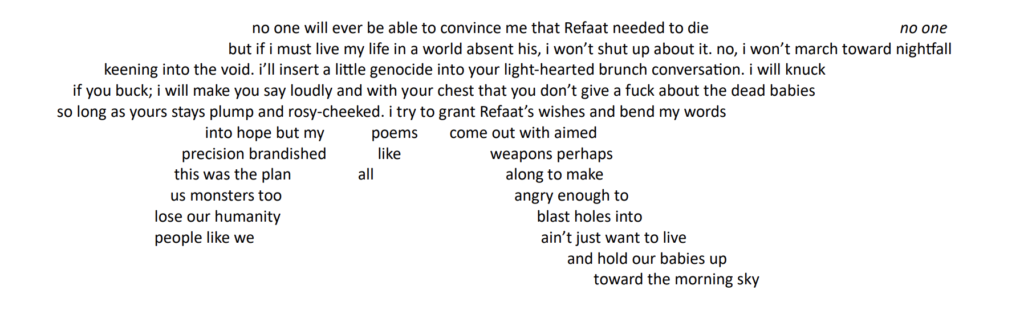
if I must live after Refaat Alareer


Kelsey L. Smoot (They/Them/He/Him) is a full-time PhD student in the interdisciplinary social sciences and humanities. They are also a poet, advocate, and frequent writer of critical analysis. Kelsey’s debut chapbook, we was bois together, recently came out with CLASH! an Imprint of Mouthfeel Press.

Anisa

Show Me

They’re usually in groups and giggle for no reason at all. They’re like those girls in movies– effortless and in full possession of themselves. They’re impenetrable but I manage somehow. I mirror their mannerisms, their snap shallow exchanges and remarks. I want to see if I can do it successfully and pass. I do it like I’m playing a game, for no reason other than to see if I can play it well. It’s a game I intend to win and master. But if I lose, it’s just a game and real life exists somewhere else. I’d then be impelled to go look for it and I’m too lazy for that.

Things having to do with movement, grace and existing in physical spaces amid people with a lightness and ease, had never come naturally to me but I’m in their sphere now. The atmosphere in our group of four, eddies around me and then back to them in swift, easy currents like cigarette smoke. I pride myself on my skill, at how I’ve become a chameleon. I didn’t possess this magic power before but now I suddenly find it in my lap. I revel in it. I intend to wean it for what it’s worth. At the tail end of my teens, I learn how to pose in photos like a normal teen girl such that it accentuates all the right angles of me, parts I didn’t even know I had. I learn how to laugh at silly TikToks and train myself to see what they see in them. I put on makeup and make sex jokes with the girls at which they guffaw and laud me because the joke is so fresh and unexpected. They say YES. This is the Anisa I wanna see. So I show them. I make their occupations and thoughts mine; adopt them, adorn myself in them because I’ve been given a pass. I’ve passed. As what you ask? One of them.

Before the party, they’re talking about a reality TV show and I slide myself in.

“Isn’t that the one with youngsters playing on the beach?” I say, a bit offhandedly. I slept at four yesterday and I’m still groggy.

She laughs and I’m confused.

“We’re youngsters, what are you talking about. The way you said it” she keeps laughing. 

“Oh right. Yeah we are hahah” I say. I forgot.

***

I look at the label on the Tropicana juice can. 100% fresh fruit, made with guava, strawberry, and cranberries. All natural ingredients. Cool water droplets cling to its aluminum surface like sweat beading my neck. I’m taken in by fabricated labelings – I let myself be. Embellishments that promise a lot but deliver little. But for the first time, they don’t go unnoticed by me. They have my attention, and not just to ensure that I’m not putting expired stuff into my mouth. Along with the juice, I gulp down all fancily typefaced words on it and the tropical beach illustrations. The juice is tasty because the potent words and labeling are swirling inside it along with its actual contents. But I am sold.

Sipping it, I believe my body is being rejuvenated this summer afternoon just like the ads promised. Suddenly, I’m a girl in a summer advert, sitting on the beach under the shade of a palm tree as the sun scorches hot and bright. An artist’s model, posing at once both unbothered and fully attuned to the camera’s gaze. I laugh looking at the now empty tinny can, giddy at how easily I slipped into this persona, this mirage. And once more, even after all this time, the incredulity at how I was even allowed to. How the spell stays unbroken despite the realization.

I play out a fantasy; fill in the colors inside the outlines because I can now. I don’t do it to hold up the picture to someone and say, look, but to show myself the picture and believe that I can inhabit it and look like someone in her natural habitat. I want to break the conceptions I have of myself and expand its boundaries.

***

I’m climbing a hill, thousands of miles away from the tiring upkeep of youthfulness. Despite the tiring climb, I’m relaxed, with my cousins behind and ahead of me.

We stop to take a selfie at the top of the hill. My lower body is out of the photo but my torso is leaning into the frame as I smile a full-lipped smile. My lips pucker ever so slightly. My face is leaning forward too; my whole being always bending toward something, assuming a shape that isn’t mine. After the photo, my cousin laughs and says, Look at her pose and pout.

What are you even trying to do?

I wasn’t posing, I say. And I wasn’t. I’d assumed the pose out of habit. It had become second nature. But they see through and I’m caught in the act. I don’t pass. But this time I’m glad I don’t.

“So, anything new with you Anisa, now that the first year is done?” he asks when we’re in the car. And I know what he’s insinuating, teasing.

“I don’t like guys” I say.

He waits, expectant.
 
“Or people” I finish off, with my characteristic cynical flair. We both grin as he pulls over the car in front of the restaurant where we’re supposed to meet his friends for dinner. I feel the freely growing, wild vines inside me after a long time and I don’t clip or prune them, unruly and unyielding as they are. As I walk into the restaurant and greet his friends, I feel their tangle and let it show. Let it show.


Anisa is a writer living in Wisconsin. Her essays and stories have previously been published in Vagabond City Lit and recognized by the UK Poetry Society and Cambridge University. Twitter: @janodeigh. She writes a blog on Substack.

Sarena Tien

Mother Tongue

In Mandarin, my mom tells me,
The house doesn’t have any crayons.

I ask why she needs them, but she replies,
No, not crayons, the little round things.

I don’t understand. What round things?
The little round things like rice! she says.

I frown down at my own bowl of rice
before realizing, “Oh! You mean quinoa!”

As we laugh, I tuck the mistake into my heart
next to her other mispronunciations

potato gardens (botanical gardens)
watergrass (watercress)
las vegas (asparagus)
garbage (cabbage)


ingredients for a love letter
between an immigrant mother
and a second-generation daughter.

Editor’s Note: An alternate version of this poem first appeared in Philly Chapbook Review.


Sarena Tien (she/her) is a queer Chinese American writer and feminist. Once upon a time, she used to be so shy that two teachers once argued whether she was a “low talker” or “no talker,” but she’s since learned how to scream. Her poetry and prose have appeared in publications such as Bustle, The Rumpus, and Snarl. She holds a PhD in French Literature from Cornell University.

eric morris

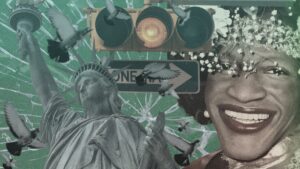
Rioting with Marsha P. Johnson

I take Marsha P. Johnson’s hand into mine, collecting sweat between our palm lines. Cold sweat.
She smiles back into my throat as we miss the intersection, J walking across the street, impatient.
Our fingers are wrapped into each other’s grooves when she offers to share her lipstick with me.
I say yes, and I beat my face down to match her contours and complexion. We take turns yelling
“Fuck this city! Fuck this city!” But at the same time, we are the blood of this city—rushing
through the streets like body currents, veiny intersections like aoritic highways. We are the
lifeblood of the city. A crowd surrounds us, pulsating like a heartache. Marsha bends down into
the current to grab a stone. I bend with her. And she chucks the thing through someone’s window
(someone spitting at us). We laugh as the shattered glass brocades the air in sparkling pieces and
the dimples we wear swallow our teeth. We lift the bottoms of our dresses to run the rest of the
way to Central Park, where we will feed each other stories and kiss softly.


eric (any/all) is a writer and sensitive soul currently bending the edges of their tarot cards in Hopkinsville, KY. They hold a B.A. in English from the University of Nebraska–Lincoln and have worked editorially with HG Literary, Prairie Schooner, and Split/Lip Press among others. When they are not professionally overthinking, eric finds time to read, lightly strum their bass guitar, and play video games. Their work appears in Stanchion, Embryo Concepts, and Wild Roof Journal.

Abubakar Sadiq Mustapha

Artist Statement

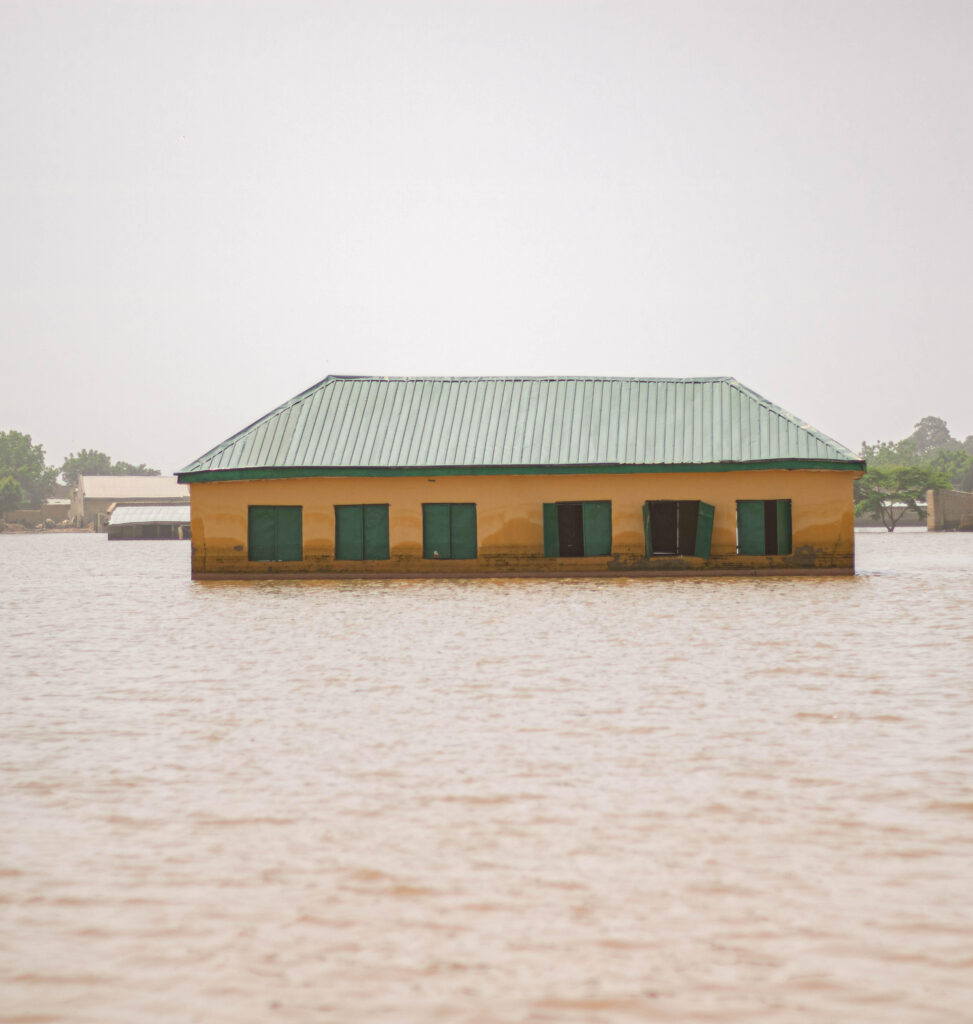
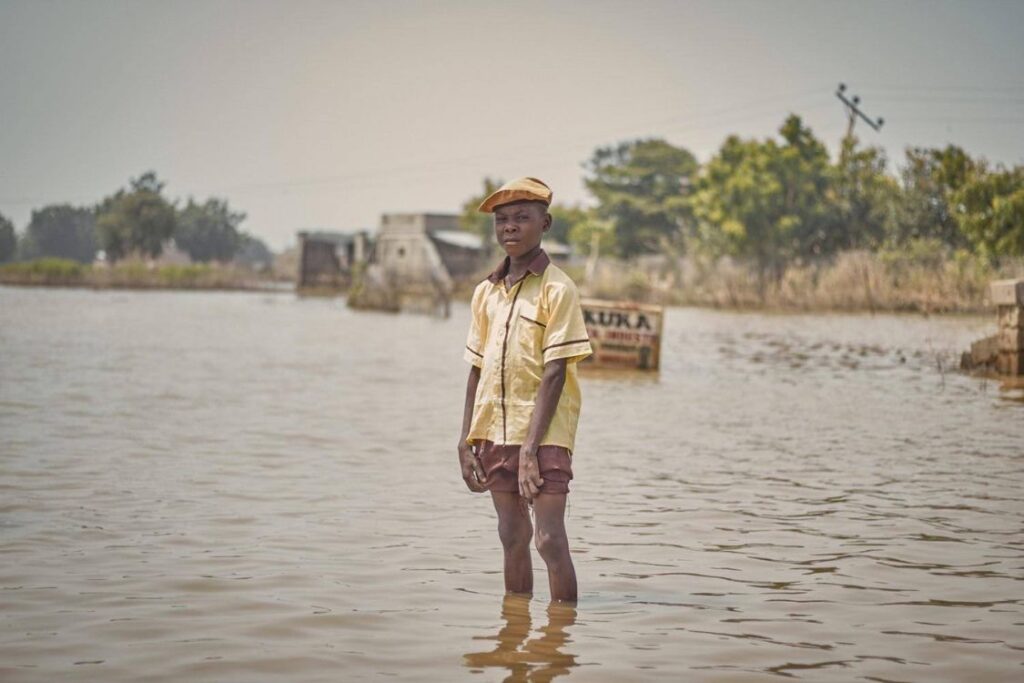
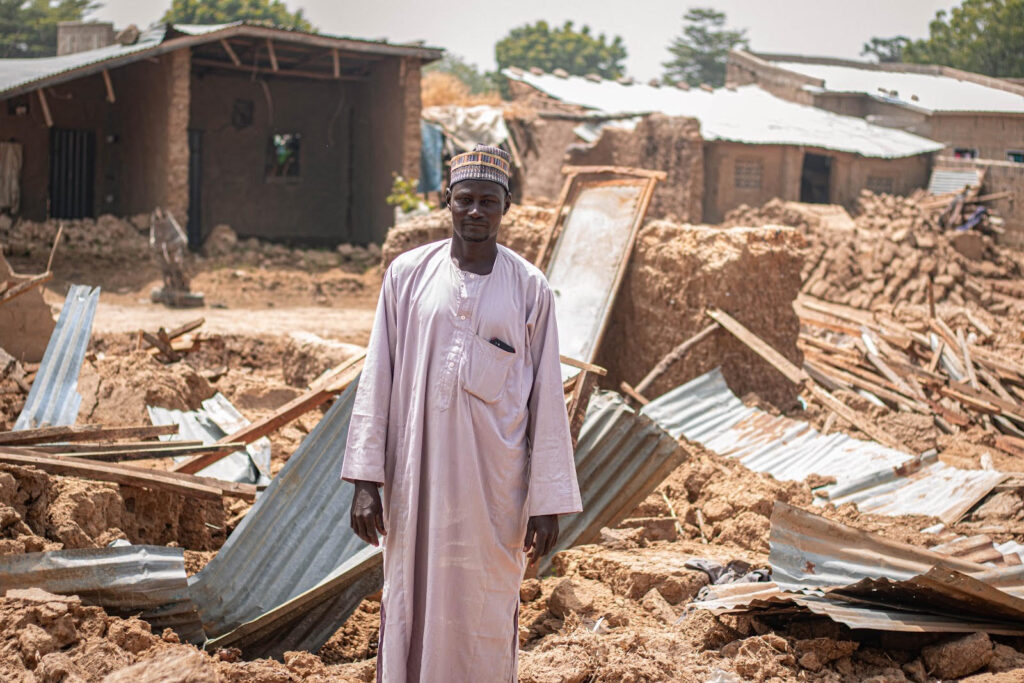
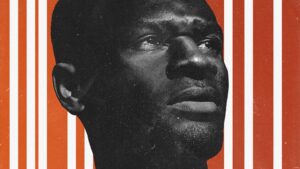
I want to showcase the impact of climate change on education through this image of a young boy, eager to attend school but forced to turn back due to flooding that has rendered his school unusable.

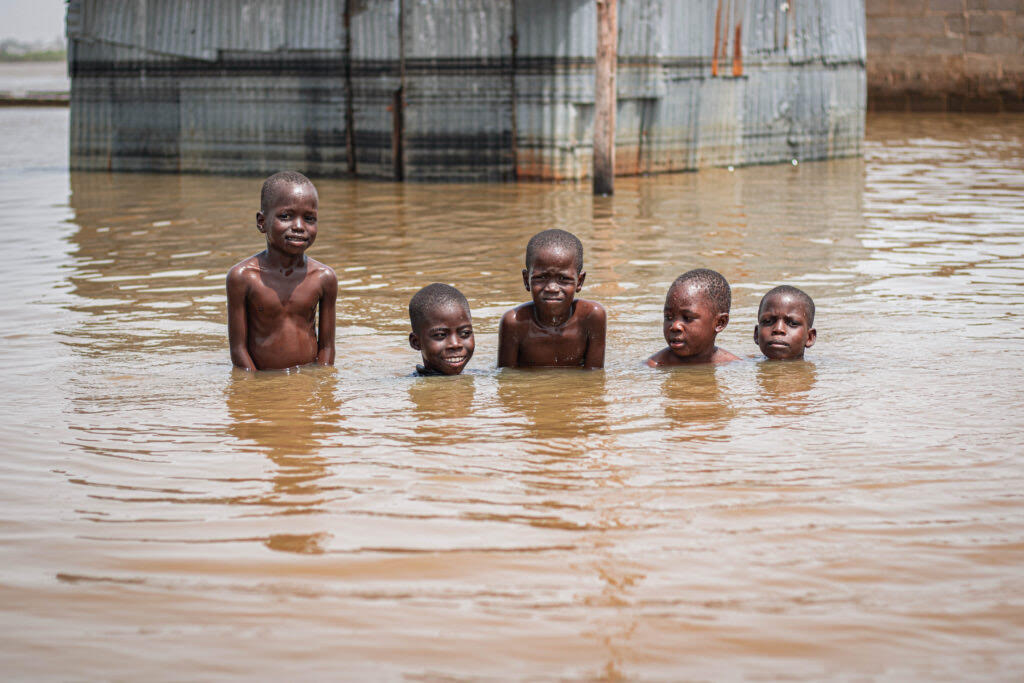
In contrast, I also want to highlight the joy and beauty of human connection through this heartwarming picture of young boys laughing and playing together, showcasing the unbreakable bonds of friendship.

*All artwork is featured with the permission of the artist. Please ask for permission before sharing any content.


Abubakar Sadiq Mustapha is a multimedia storyteller whose works focus on climate change, displacement, identity, and culture. He believes in the power of photography and how it can be used for mental health and development. His work has appeared in the Ebedi Review, Ake Review, Lolwe, Panorama: The Journal of Travel, Place, and Nature, The Nigeria Review, The Shallow Tales Review, Libretto Magazine, Salamander Ink Magazine and elsewhere. He is one of the finalists for the Africa Soft Power Climate Change Photo Essay Prize and was selected as one of the overall best for the Wiki Loves Africa 2023 Photography contest in Nigeria.

To Swallow the Sun Playlist

Thank you for listening to Hellebore Radio. Here we have a wide and varied selection of musicians and bands for you to listen to!

Where to start? How about Not that Bad in LA by Allie X if you’re feeling a little sassy. Blood Type by Cautious Clay always gets me hyped up. Feeling a little more mellow? In your feels? Try Choke Throat by Goon. Listen to Take it All by Helena Deland for a more intimate feel or even Come Over by The Internet for chillin’ on a late night.

Love and light!

Denise Nichole
Editor in Chief

Leave a Comment

Your email address will not be published. Required fields are marked *

Lyrics as Poetry: An Interview with Sara, Erik, and Justin

Music can be described as a layered process of melodies and instruments that mesh together to form a song. The genres range from folk, hip hop, metal, to lo-fi surf rock, neo-soul, and beyond. Each of these genres contribute to the scene ultimately defining a generation of riot grrls, punks, or oldheads. The roots of music can be political and/or cultural—leaning into our identities and philosophies as both individuals and communites. But how else can listeners appreciate the music for its artistic and entertainment value?

Through,

Lyrics as Poetry

of course!

How has your background influenced your desire to create a publication for songwriters and prose writers?

Sara: Lyric booklets have always been scattered throughout my apartments. Reading the lyrics of an album I admire, separated from the music, allows me to appreciate the creativity it takes to turn those words into music. As a songwriter, lyrics are the foundation and so much time and heart can be spent writing them. I wanted to create a book that I’d want to read.

When I first lived in New York, I worked at an intimate venue called City Winery. Night after night, I would listen closely to many great songwriters and their words. That helped form my taste in music, helped me find my voice as a songwriter.

Describe the process of writing a song. How are poetic elements inextricably linked to songwriting? In what ways are both arts forms dependent on one another?

Sara: Lyrics can be read on their own like a poem, and interpreted separate from the music. In that way, at the very least, they are linked. For my songwriting process, I like to look back at poems or my own notes and pick out lines or concepts. Then I’ll take some of those lines and sit down at the keyboard and just play and sing those lines, and improvise off them and see if anything sticks. So much time can be spent finding that perfect word or phrase — or words may just end up tumbling out from somewhere deep in my subconscious.

What is it a about Los Angeles that fuels creativity and freedom of expression? Have these surroundings influenced your craft?

Sara: An L.A. Times columnist wrote recently, “L.A. doesn’t have seasons, it has moods.” There’s so much diversity of creative thought within this expansive city. And there are so many beautiful places within a short driving distance which helps me get out of my head. And the beautiful light here.

What artists, writers, and or songwriters speak to you? In what ways have they contributed to your artistic narrative?

Sara: Just to name a few: Cat Power, Hope Sandoval, Joni Mitchell, John Lennon. I love the simplicity in their songwriting, the vulnerable tone in their voices, how they can make accessible, relatable themes unique to their own voice and deliver it in such a creative way. I draw a lot of inspiration from writers and poets as well: Joan Didion, Edward Abbey, Sandra Hochman, Mark Strand, Pablo Neruda, Mary Oliver, to name a few.

Are there any other modes of expression that inspire your songwriting? How so?

Sara: Creating and curating this journal has allowed me to learn about so many different artists. The process of working with Justin has been a great learning in the art of graphic design as well, incorporating all the elements of design, paper and printing is an art form in itself.

Erik, what inspired you to participate in Sara’s vision for Lyrics as Poetry? How did you collaborate together to see the vision through?

Erik: We both love reading in print, browsing stores and finding new music-themed publications, books and zines. The idea for Lyrics as Poetry first came up in the Summer of 2015, before we had that title, as a way to browse through song lyrics and sit with them as we would on a Sunday morning with a newspaper section.

What is your area of expertise? Has it shaped your involvement with Lyrics as Poetry? In what ways?

Erik: My background is in journalism and recent work has been as a news editor. When Sara and I first started creating Lyrics as Poetry, we brainstormed several ideas for how a print literary journal featuring song lyrics could look — from the presentation to layout, theme and what type of features and contributors we’d like to include. Reading and working with writers (there are 20 prose contributors in Vol. 2 and 10 in Vol. 1) has been a great process.

Lyrics as Poetry features minimal, simple, crisp, and yet refined design. How does this approach center the work of songwriters and prose writers?

Justin: The simplicity of the design allows the structure of the page to step aside so that the reader can focus on the words. We wanted the design to set an elegant tone, hold up the text, then step aside and allow the shapes of the lyrics to do their thing. We really wanted to quietly celebrate the texts with this book and the simplicity of the design naturally helps to do that.

When developing the design, do you let the work lead your direction, or do you start off with a plan and go from there?

Justin: Sara had some ideas when she first approached me with the project. She knew what world she wanted to the books to come from so we were able to build from there. We spent some time developing our pallet of fonts, type styles, and general look and feel, then once we liked how all the pieces worked together, we started working with selections of lyrics to let the lengths and shapes of the texts help fine tune the design.

What publications do you read? What is it about these publications that resonate with you?

Sara & Erik: Desert Oracle is one of our favorite small-press journals. California Sunday is a gem, with great photography and design sensibility and also some of the best longform journalism around. Cereal’s simple and beautiful aesthetic is a design influence. We subscribe to The Los Angeles Times daily and New York Times on Sundays. They both feature many stories that we’d never find ourselves clicking on online, but are important and engrossing reads that matter and sometimes make more sense in print. And The New Yorker, it’s the best.

What are your hopes for the future of publishing? How have you sought to contribute to that change?

Sara & Erik: We’ve exhibited at art book fairs and zine fests  over the last couple months — it has been a great community to be a part of — so many burgeoning small-presses, which is encouraging. We hope this book is something that someone can put on their music stand or coffee table, and pick up when they need some inspiration. I think there’s a craving for something that can be kept and doesn’t disappear.  

Any recommended listening? Or albums/songs/ artists?

Cat Power’s You are Free
Mazzy Star’s So Tonight That I Might See
Beth Orton’s Daybreaker
Iron & Wine’s Shepherd’s Dog
Joni Mitchell’s Blue
Neil Young’s Harvest
John Lennon’s Walls and Bridges
Nick Drake’s Pink Moon
Conor Oberst’s self titled album
Modest Mouse’s The Moon and Antarctica 
Alice Coltrane’s Journey in Satchidananda

When selecting and curating content for the Lyrics as Poetry Volumes, what do you look for?

Sara & Erik: We start by creating a loose theme for each volume, then look for lyrics that fit that theme. The songwriters are an eclectic set, emerging and established artists that span multiple genres. Every artist grants us their permission to print their lyrics. It’s great seeing all the different artists in the mix and how they all play off of each other.

Also each song must be a recorded work. We hope the journal also serves as a way to find and discover some new artists or get reacquainted with some you may know. Finding an artist by reading their lyrics first and then listening to the song is a great way to learn about some songwriters that you may not have found otherwise and can make the listening experience that much more personal and special.

The current climate of publishing in the arts, music, and literary world is concerning. Especially when we consider pathways towards inclusion and equity. How do you hope to establish trust and confidence in those who seek to be part of the field/industry? What problems and issues have you hoped to address through Lyrics and Poetry?

Reading each Lyrics as Poetry volume is far more interesting having so many voices represented (62 total contributors for Vol. 1 and 57 for Vol. 2). Songwriters who are featured don’t need to have reached a certain threshold on Spotify or iTunes charts but just have compelling lyrics to share. Writers who pitch a track spotlight aren’t just full-time journalists, but people who have an interesting and personal take on a song lyric.

To listen to the albums recommended by Lyrics as Poetry, check out the playlist below! And stay tuned for the release of Lyrics as Poetry Vol. 3 which is due in the summer!


Lyrics as Poetry is a new print-only journal spotlighting the work of singer-songwriters, where lyrics can be appreciated on their own, as art on the printed page, along with personal notes from artists and journalists.

Leave a Comment

Your email address will not be published. Required fields are marked *

Decolonize Your Syllabus: An Interview with Yvette DeChavez

Yvette DeChavez, PhD, is a writer, artist, and scholar that hails from San Antonio, Texas. She is a first generation college graduate and studied Indigenous Americans and People of Color. In addition to her contributions within academia and media, Yvette DeChavez advocates for mental health.

In 2018, Yvette DeChavez utilized her platform to call attention to the lack of representation in college level English classes. In an article published by the Los Angeles Times, DeChavez demanded college campuses, universities, and individuals nationwide to:

Decolonize Your Syllabus!

In this current climate, many voices and experiences are silenced. Unfortunately, that extends to spaces that were once deemed as safe.  How is academia changing? How has that affected your role as an educator?

When I returned to the classroom two days after the (2016) election, the tension was palpable. I was TAing for an American Lit class at the time, and I could tell that the professor (a liberal white guy) was uncomfortable and unsure of how to address the elephant in the room. On one hand, there were students who’d voted for Trump. On the other, we had queer students, undocumented students, students wearing “Fuck Trump” shirts, all of whom were seething with anger. I knew things were going to be intense after that, and that I would have to decide how I was going to approach this as an educator—would I stay quiet so as to not ruffle feathers, or would I stand up for what I believe in, which is that aligning yourself with Trump is aligning yourself with the denial of basic human rights and dignity? I knew that if I chose the path of least resistance, I’d be doing a disservice to the students whose lives and voices were at risk. I choose to teach resistance. Not everyone is doing the same thing, but there are plenty of us who are out there doing this work and doing it loud.

In what ways do you think, students, faculty, and administration alike, can contribute to an inclusive and equitable environment with education?

I think the entire institution sees white as the default, because the institution itself is largely made up of white people. The higher you go, the whiter it gets. (Hey, they don’t call it the Ivory Tower for nothing.) I think it would require a process of unlearning, rethinking, and listening to BIPOCs as they try to explain why things feel so unwelcoming and hostile. I think faculty and administration are in a position of power, which means it’s up to them to do the work of making themselves better, of holding themselves accountable. Read books! Read the internet! The tools are everywhere and absolutely available—it’s up to them to make use of them. Additionally, there are tons of academics of color who are doing the work of decolonizing and diversifying. Hire us! Hire us for teaching positions, hire us to speak to faculty and administration, hire us to host workshops.  

How have you used your platform to challenge prejudice and discrimination within academia?

As a literature instructor, one of the most important aspects of my job is teaching critical thinking skills. Critical thinking and challenging prejudice and discrimination go hand-in-hand. So basically, it’s my job to use my platform in this way. Obviously, not everyone sees it this way, but I do.

What situation sparked the #DecolonizeYourSyllabus initiative? What conversations and actions do you hope to spark because of this initiative?

Last year I held a postdoc position and, just before classes began, I received an email from a professor with some power in the department who decided that the reading list for my American Novel class was too “ethnic” and that I needed to add white men to the syllabus, particularly because it was an American Lit class and not an “Ethnic American” lit class, as they phrased it. They also added that it would make me look better on the job market.

I was, of course, pretty upset about the entire thing. But I also knew that my postdoc was only a year long, and that after it I planned to take a break from academia and reconsider whether or not I even belonged there. So, to be quite honest, I thought “To hell with this, I’m going to teach what I want,” because I wasn’t sure I’d ever get the opportunity to do so again. I removed the only novel by a cishet white woman on the list and replaced it with a text by another WOC, and I made it a point to begin the semester by explaining to my students that the list in front of them was one I chose on purpose, with intention.

It’s no secret that most of us spend our years in higher education reading text after text by white men, and look at where that’s gotten us. It becomes the only perspective we’re given and it starts to feel like the only one that matters. I believe that this is detrimental to students: white students never have to consider the perspectives of indigenous and POC Americans; indigenous and POC students feel like their perspectives aren’t important. The cycle goes on and on and on—we reinforce and perpetuate the system.

            I also want to add—and this is really important to point out—this is a radical call for change. I’m not saying “DIVERSIFY your syllabus,” I’m saying “DECOLONIZE.” And that’s the part that upsets a lot of people. Yes, I actually mean that, in order to truly shake shit up, you should primarily teach indigenous and POC texts. I’m not calling for people to sprinkle in more works by indigenous and POC writers; I’m calling for them to make these voices the dominant ones in their classroom.

Some people try to say things like “Well, you know it’s impossible to change things from inside the institution, right?” And sure, I get that. But at the same time, shouldn’t we try? What is the alternative when right now this is the system under which we operate? For me, decolonizing your syllabus is a step towards something good, something better. I hope that it shakes shit up and allows students and professors to push against whiteness as the default, whiteness as the norm.

Eventually, I also hope that it means we move entirely away from Western and colonial ways of thinking.

How can the English Department across universities nationwide create a literary canon that represents the students they teach?

The canon is a funky thing, right? I mean it’s constantly evolving and the concept itself is feels a little outdated to me, particularly given the way the internet is changing how we access works. I’m not sure how I feel about the concept of the canon anymore. I mean, I do think Toni Morrison is One of the Greats, but have you ever read Kiese Laymon? How about Yesika Salgado, who really got her career going thanks to social media? Their work is changing people’s lives, and I doubt most would consider them canonical. The thing is, I can pretty much guarantee you that what I consider canonical will be quite different than what my white male advisors would include, or even what someone who shares my interests might believe.

Am I saying fuck the canon? I don’t know—maybe. Probably. Yeah, I think so. If anything, I think we should really be thinking about how white professors are going to do the work of finding materials by indigenous and POC writers rather than insisting we all read The Old Man and the Sea. I can’t tell you how many times I’ve had white instructors be like “Hey Yvette, I’m teaching Mexican American literature this semester. Can you give me some books to put on my syllabus?” Hold up—you want me to just give you all the work I’ve put all my time into finding? Pay me, dude. And that’s just it: Pay us for our extra labor. Everyone wants to diversify but no one wants to put in the work or pay people to do the work for them.

Also, for the record, I’ve never read Moby Dick, and I have no shame admitting that. 

Do you have any literature or poetry recommendations for our readers? How have these works influenced you?

Jesmyn Ward’s Salvage the Bones: This book hurts. It’s about Esch Batiste, a pregnant fifteen-year-old girl who is growing up without her mother in Mississippi. The bulk of the novel takes place in the days before Hurricane Katrina hits, as Esch and father and brothers prepare for the storm and Esch comes to face the fact that she will be a mother. I’ve read this book four? five? times (I wrote about it for my dissertation), and it gets more painful every time. But damn, it’s something you have to read.

Kiese Laymon’s Long Division: This one is about a smart-ass kid named Citoyen, who is also growing up in Mississippi. It’s a trippy book that’s part sci-fi, part coming-of-age, part Afrofuturism, and it totally changed the way I think about time and anti-Blackness in America. 

See also: Sandra Cisneros’s Woman Hollering Creek, Leslie Marmon Silko’s Ceremony, Frantz Fanon’s Black Skin White Masks, Celeste Ng’s Everything I Never Told You, and Ingrid Rojas Contreras’s Fruit of the Drunken Tree


Yvette DeChavez is a Latinx writer, artist, and activist from San Antonio, Texas. She earned a PhD in Literature from the University of Texas at Austin, where she also taught classes in contemporary American literature and Mexican American culture. Her work focuses on centering the voices, narratives, and performances of BIPOC. She is also a mental health advocate who speaks openly about her experiences with depression and anxiety in hopes of normalizing such conversations. Before earning a PhD in literature, she worked for the Macondo Foundation, a nonprofit organization that brings together writers committed to social change. You can find her on Instagram @yvettedontlie. For “Decolonize Your Syllabus” shirts, visit her website: www.yvettedechavez.com.
One Comment

  1. Pingback: Virtual Visionaries Week 6: Art Inspired by Identity – Paul R. Judy Center for Innovation and Research – PRJC

Leave a Comment

Your email address will not be published. Required fields are marked *